
You don’t just lose the sale when a customer disputes a card payment. Your acquirer or payment service provider (PSP) also charges you a fee for handling the dispute, and it usually comes straight out of your balance along with the disputed amount.
Here’s the part that trips merchants up. Win the dispute and you normally get the sale back, but not the fee.
One fee looks small. The problem is how quickly they stack up. A high dispute rate can pull you into card network monitoring programs with monthly fines, and in the worst case it can cost you your merchant account.
This guide explains what a chargeback fee is, how the process works, what the major PSPss charge, and the practical steps that keep these costs down.
Key takeaways at a glance
- A chargeback fee is what your payment processor charges to handle a dispute, whether you win or lose.
- Most PSPs charge a flat fee per dispute, and some, like Square, charge nothing.
- Winning a dispute rarely returns the fee.
- Visa and Mastercard add their own fines once your dispute ratio crosses their thresholds.
- Prevention lowers fees; fighting illegitimate disputes recovers revenue.
What Is a Chargeback Fee?
A chargeback fee is a charge your acquirer or payment processor adds to your account each time a customer’s bank reverses a card payment through a formal dispute. It covers the administrative work of processing the case, and it applies on top of the disputed amount, which is withdrawn separately.
The fee is set in your merchant agreement, not by law, so it varies by provider, country and risk profile. For most online merchants it’s a flat amount per dispute. Stripe, for example, debits “the disputed amount plus a dispute fee” as soon as a dispute is opened.
Two things make it different from other processing costs. It’s charged regardless of who is at fault, and it’s usually non-refundable. It also acts as an incentive: the processor wants you to prevent disputes, not just absorb them.
How Do Chargeback Fees Work?
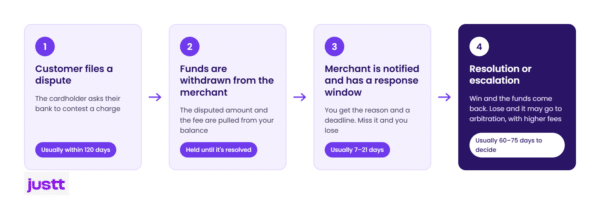
Every card network has its own rules, but the fee follows the same basic path.
Step 1: Customer Files a Dispute
The cardholder contacts their bank to contest a charge. Card networks typically allow disputes within 120 days of the payment, and for future services like travel or events the clock can start on the event date.
Step 2: Funds Are Withdrawn From the Merchant
Your processor pulls the disputed amount and the chargeback fee from your balance. The funds are held for the entire dispute, and you can’t issue a separate refund while it’s open.
Step 3: Merchant Is Notified and Has a Response Window
You get a notice with the reason for the dispute and a deadline. That window is usually 7 to 21 days, depending on the network and your PSP. Miss it and you lose automatically.
Step 4: Resolution or Escalation
If you submit evidence, the issuer usually has 60 to 75 days to decide. A win returns the disputed amount. A loss keeps it with the cardholder, and some cases escalate to pre-arbitration or arbitration, which carry higher fees.
How much do chargeback fees cost?
What you pay depends on your provider and your merchant agreement. Here’s what the major PSPs publish for US merchants.
Standard Chargeback Fees
| Provider | Fee per chargeback (US) | Returned if you win?
|
|---|---|---|
| Stripe | $15 dispute fee, plus $15 if you counter | Only the $15 countering fee |
| Shopify Payments | $15 | Yes |
| PayPal | $20 for card chargebacks; $15 for PayPal disputes | No |
| Amazon Pay | $20 | No, unless covered by Payment Protection |
| Square | $0 | N/A |
Shopify is the outlier on refunds: its help center says “if you win the chargeback, then the fee is returned to you.” Square says it charges no fees for dispute management at all.
High-Risk Merchant Fees
High-risk merchants pay more, because acquirers price in the higher chance of losses. Fees for high-risk accounts are negotiated per contract and can run well above the standard rates. To find out the exact amount, read a high-risk acquirer’s published pricing page. However, in general, typical chargeback fees for high-risk merchant accounts can reach above $100 per chargeback.
Some PSPs also raise fees automatically once your disputes climb. PayPal moves sellers to a $30 high volume dispute fee when their dispute rate reaches 1.5% or more over more than 100 sales in the previous three months.
Chargeback Monitoring Programs
Your processor’s fee is only the first layer. Visa and Mastercard also run monitoring programs for merchants whose dispute levels exceed set limits, with fines on top of per-chargeback fees.
Visa consolidated its dispute and fraud programs (VDMP and VFMP) into the Visa Acquirer Monitoring Program (VAMP), so older fee tables built around VDMP no longer apply. Mastercard runs the Excessive Chargeback Program.
| Program | Who gets flagged
|
|---|---|
| Visa VAMP (Excessive Merchant) | VAMP ratio of 1.5% or more and at least 1,500 fraud reports and disputes a month (Enforced in US, Canada, EU and Asia Pacific from April 1, 2026) |
| Mastercard ECM | 100–299 chargebacks and a 1.5%–2.99% chargeback rate |
| Mastercard HECM | 300+ chargebacks and a 3% or higher rate |
Each network calculates its chargeback ratio differently, and Visa counts fraud reports as well as disputes. And monitoring programs don’t consider dispute outcomes, so winning a case doesn’t lower your ratio.
If you’re getting close to these thresholds, it’s time to invest in a chargeback mitigation solution that helps you manage disputes before they push you over.
The True Cost of a Chargeback
The fee on your statement is the smallest part of what a chargeback costs you.
Direct Costs
Start with the disputed amount itself, the chargeback fee, and any countering fee you pay to respond. Add the goods you shipped and usually can’t get back.
Hidden and Indirect Costs
Then come the costs that never appear as a line item: staff time spent gathering evidence, customers you lose, and the fraud tools you buy to stop it happening again. The LexisNexis True Cost of Fraud study found that US ecommerce and retail merchants incur an average $4.61 for every $1 of fraud. A high dispute rate can also lead to reserves, higher processing rates or account termination.
Arbitration Fees
If a dispute escalates past the issuer’s decision, the network steps in, and the loser pays. At Visa, the party that loses arbitration is liable for a $600 filing fee; at Mastercard, a merchant can incur a fee of up to $600. Some PSPs don’t offer this stage at all: Stripe doesn’t support arbitration, though it collects a $500 network fee to contest Visa or Mastercard compliance disputes, refunded if you win.
Are Chargeback Fees Refundable?
Usually not. Even if you win a chargeback, the fee your acquirer or payment processor charged is typically non-refundable. Winning returns the disputed amount; the fee stays with the processor, because it covers the work of handling the case, not the outcome.
The details depend on your provider:
- Stripe never returns the dispute received fee, but refunds the $15 countering fee if you win.
- Shopify Payments returns the fee when you win.
- PayPal doesn’t reimburse its high volume dispute fee, even if you win on appeal.
- Amazon Pay charges its $20 fee regardless of outcome, unless the chargeback is covered by its Payment Protection Policy.
Card network fines are separate. They’re triggered by your dispute count and ratio, so a win doesn’t reverse them either.
How to Reduce Chargeback Fees
The only reliable way to pay fewer chargeback fees is to receive fewer chargebacks. These steps target the most common causes, and our guide to preventing chargebacks goes deeper.
Improve Customer Communication and Service
Many disputes start with a customer who couldn’t reach you. Put your contact details on your site, receipts and order emails, and answer complaints quickly. A customer who gets a reply is far less likely to call their bank.
Use Clear Billing Descriptors
If customers don’t recognize the name on their card statement, they assume fraud. Use a billing descriptor that matches the brand name they know, and include a phone number or URL where your processor allows it.
Process Refunds Immediately
A refund issued before a dispute costs you the sale. A chargeback costs you the sale plus a fee. Once a dispute is open, you can’t refund outside the dispute process, so act on refund requests the same day.
Streamline Your Returns Process
Make your return policy easy to find and easy to use. Self-service return portals, clear timelines and status updates all remove reasons to dispute.
Implement Fraud Prevention Tools
True fraud chargebacks are preventable with the right screening. Use tools that score transactions in real time and apply authentication, such as 3D Secure, on higher-risk orders.
Monitor Your Chargeback Metrics
Track your dispute count and ratio per card network every month, not just in total. Chargeback alerts from Ethoca and Verifi also warn you before a dispute becomes a chargeback, giving you the chance to refund first.
Additional Chargeback Fees for High Chargeback Ratios
Once you’re in a monitoring program, the fines climb every month you stay there. They reach you through your acquirer or PSP, which notifies you when a fine is assessed.
Visa VAMP
A merchant that breaches the Excessive threshold pays $8 per dispute or transaction reported as fraud.
Mastercard Excessive Chargeback Program
| Months in program | ECM fine | HECM fine
|
|---|---|---|
| 1 | $0 | $0 |
| 2 | $1,000 | $1,000 |
| 3 | $1,000 | $2,000 |
| 4–6 | $5,000 | $10,000 |
| 7–11 | $25,000 | $50,000 |
| 12–18 | $50,000 | $100,000 |
| 19+ | $100,000 | $200,000 |
From month 4, an issuer recovery assessment of $5 applies to every chargeback over 300. To exit, you need three consecutive months below the threshold.
Playing chargeback defense
Chargeback fees add up fast when no one is watching them. Prevention cuts the number you receive. For the rest, you need a defense that fights the disputes worth fighting.
That’s where Justt comes in. Our Dispute Optimization predicts the return on each case, weighing win likelihood, fees and chargeback value, and recommends whether to fight or accept. Our AI then builds a tailored response for every dispute you contest, helping you recover more revenue. And with success-based pricing, you only pay when we win funds back.

Merchant Chargeback Fees FAQs
Do merchants get penalized for chargebacks?
Yes, once they exceed network thresholds. Visa’s fine for excessive chargeback merchants, passed on by your acquirer, is $8 per dispute or fraud report, and Mastercard fines range from $1,000 to $200,000 a month. These come on top of your processor’s fee.
Why did I get a chargeback fee?
A customer disputed a payment with their bank, and your payment processor charged you for handling the case. It also gives you an incentive to prevent disputes.
Why are chargeback fees so high?
Each dispute involves several parties: your processor, the card network and the issuing bank. The network debits your processor for the dispute and related fees, and your processor passes those costs on along with its own handling costs.
How much does a chargeback cost a business?
Much more than the fee. Add the lost sale, the goods, staff time and any network fines, as covered in The True Cost of a Chargeback above.
What is considered a high chargeback rate?
Stripe says the industry treats dispute activity above 0.75% as excessive. Visa’s Excessive Merchant and Mastercard’s ECM thresholds both sit at 1.5% in most regions.
What is a chargeback fee on my bank statement?
For merchants, it’s the per-dispute fee your processor deducts, usually listed next to the disputed amount on your payout or processing statement. If you’re a cardholder, a chargeback line is normally the disputed payment being returned to you.
Do chargebacks affect credit scores?
Not directly. A chargeback is a payment dispute, not a credit obligation. The bigger risk is MATCH. Acquirers must report merchants they terminate for excessive chargebacks, and listings remain active for 5 years, making it very hard to open a new merchant account.