The question isn’t whether you can build your own AI chargeback solution. It’s whether you should.
We understand the appeal. AI tooling is more accessible than it has ever been. Your engineers are talented. Your payments team knows your disputes better than any outsider. When a problem costs you real money every month, the instinct to own it is a reasonable one.
So let’s be clear about what we’re not saying. We’re not saying you can’t build it. Capability is not what’s in question here.
What matters is whether owning this problem is the right use of your team’s time, your budget and your engineering capacity. For most companies, it isn’t. A chargeback system is a product you commit to running, improving and defending for as long as you take card payments.
Below are the five reasons we think most merchants should buy rather than build, plus an honest look at the rare cases where building does make sense.
Key Takeaways
- The AI model is roughly 20% of the challenge. The real complexity (data infrastructure, card scheme formatting, issuer-level logic) takes years to build properly.
- Your internal model trains on your disputes only. A specialist platform learns from millions of disputes across thousands of merchants. That gap isn’t closed quickly..
- Card network rules change constantly. An internal team usually discovers a change after disputes have already been lost. A specialist platform adapts before most merchants notice.
- Building once is a myth. You’re committing to continuous rebuilding, updating and maintenance, which permanently pulls engineering away from your actual product.
- With success-based pricing, a vendor only gets paid when you recover revenue. Your internal tool costs money whether it works or not.
Where Building Chargeback Management Solutions Goes Wrong
Let’s start with the case for building, because it’s a legitimate one.
If you process thousands of disputes a month, owning the infrastructure feels logical. You control the data, the logic and the roadmap. There’s no vendor dependency and no revenue percentage going out the door. Your team already understands your products, your customers and your fraud patterns.
That reasoning is sound as far as it goes. The problem is what it leaves out.
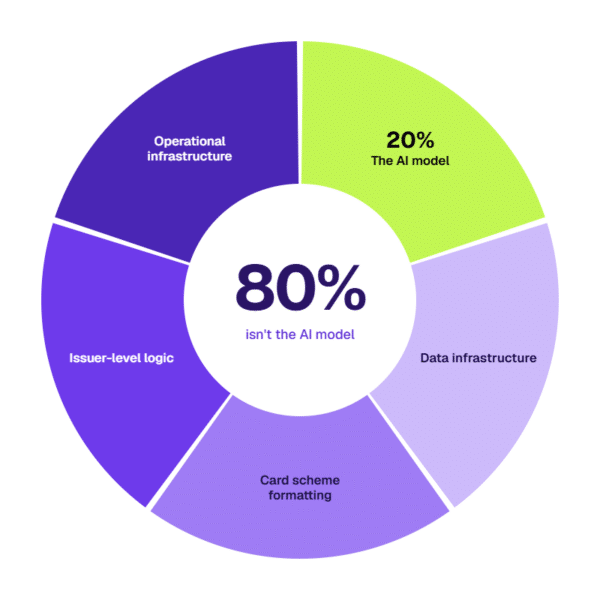
The AI model is only about 20% of the actual challenge. The other 80% is less visible and much harder:
- Data infrastructure. Pulling the right data from the right systems: your PSPs, your order and fulfillment records, your customer logs and any third-party sources that strengthen a case.
- Card scheme formatting. Structuring evidence to each card network’s specific requirements, reason code by reason code.
- Issuer-level logic. Adapting to how individual issuers actually decide cases, which rarely matches the rulebook exactly.
- Operational infrastructure. Handling volume at scale, hitting every deadline and absorbing seasonal spikes without quality slipping.
That’s not a sprint. That’s years of work. And once it’s built, the work doesn’t stop.
Five Reasons Most Merchants Shouldn’t Build an In-House Chargeback System
None of the points below says your team isn’t capable. Each one is about what building really costs over time, and who carries the risk when it goes wrong. For most companies, these five considerations settle the question.
1. A Specialist Platform Learns From Everyone’s Losses
This is the strongest argument, so we’ll start here. AI is only as good as the data it learns from.
An internal model can only train on your own dispute history. However large your business is, that’s a single-merchant dataset: one set of products, one customer base, one mix of issuers and reason codes. When your model meets a pattern it hasn’t seen, it has very little to fall back on.
A specialist platform works from a different base. Justt has processed millions of real chargebacks across industries, geographies and card networks, and its system continuously learns from millions of disputes to refine which evidence it uses. When A/B tests find a stronger argument or evidence layout, those learnings are applied across all merchants on the platform.
That breadth produces pattern recognition an internal model can’t replicate, regardless of how good your engineers are. The limit is the data, and hiring doesn’t fix it.
The gap also widens over time. A specialist platform keeps adding data from thousands of merchants every month, while yours stays bounded by your own volume.
2. The Rules Change Constantly
Chargebacks are Justt’s entire business, not a side project. That means we’re among the first to know when card networks update their rules, when new dispute patterns emerge or when new strategies become viable.
Take Visa Compelling Evidence 3.0. From April 15, 2023, Visa changed what evidence can win a card-absent fraud dispute, based on a cardholder’s prior undisputed purchases. When Visa updated those rules, Justt had adapted strategies live within days.
An internal team faces a longer road. It has to discover the change, interpret it, rebuild the logic, test it and deploy it. Disputes are lost at every stage of that gap.
This is not a one-time problem. In 2025, Visa’s evolved VAMP consolidated five fraud and dispute programs into one and replaced 38 separate remediation processes with a single one. Every update is a new version of the same cycle for an internal team. For a specialist platform, it’s just a Tuesday.
3. Building Once Is a Myth
This is the cost that gets underestimated most often.
The AI model is roughly 20% of the challenge. The rest is pulling the right data from the right systems, formatting it to each card network’s specific requirements, adapting to issuer-level tendencies and building the operational infrastructure to handle it at scale. Even the presentation matters: by Justt’s estimate, an issuer reviewer typically has about three minutes to look at your evidence, so which evidence you put up front matters.
That takes years to get right. Once it’s built, maintaining, updating and improving it becomes a commitment that never ends. Integrations break when a PSP changes its API. Evidence requirements shift. New fraud tactics appear.
Every hour your engineers spend on chargebacks is an hour they’re not spending on your customers.
That opportunity cost is concrete. It’s a product feature that didn’t ship this quarter. It’s a checkout improvement that slipped to next year. It’s a customer problem your best people didn’t get to, because they were debugging a dispute pipeline instead.
4. Internal Tools Plateau
Internal chargeback tools tend to settle at “good enough,” usually because nothing pushes them forward.
Think about the incentives. An internal tool has no competitor benchmarking against it. Nobody compares its win rate with the market. There’s no consequence for standing still, so once the tool works well enough to stop the complaints, the roadmap moves on to more visible priorities.
A specialist platform lives under the opposite pressure. Justt’s continued success depends on staying ahead, which is why we have a dedicated product team focused on win rate improvement and recovered revenue, with no other remit.
An internal chargeback tool will compete with your core product for headcount, and it often loses that contest.
That makes this an incentive structure problem. You can fund an internal team generously and still end up with a tool nobody is pressured to improve.
5. You Pay for an Internal Chargeback Management Tool Whether It Works or Not
Justt uses a success-based pricing model. You only pay when a chargeback is recovered.
An internal tool has no such accountability. You pay for the engineering whether it works or not. Salaries, infrastructure and maintenance costs accrue regardless of your win rate.
When your internal model gets a strategy wrong and your win rate drops, who is on the hook?
Run the numbers for your own business. As an illustration, say you dispute 2,000 chargebacks a month at an average of $80 each. That’s $160,000 in disputed revenue every month. A 10-point drop in win rate costs you $16,000 a month, or $192,000 a year, on top of the engineering bill you’re already paying. With an internal tool, that loss simply lands on your P&L, and nobody’s contract changes.
That’s the real cost of a tool with no accountability mechanism. With Justt, misaligned incentives are impossible: if a dispute isn’t won, we don’t get paid.
What You’re Actually Signing Up For When You Build
“We’ll build it internally” sounds like a single decision. In practice it’s a long list of permanent commitments:
- Specialist hires across engineering, data science and payments domain expertise, people who are hard to find and easy to lose.
- Rule monitoring across every card scheme you operate on, plus the acquirers and PSPs that interpret those rules differently.
- Integration upkeep for every PSP and data source, each with its own formats and API changes.
- Model retraining as dispute patterns and friendly fraud tactics evolve.
- Volume spikes after peak season, a product launch or a billing change, which a fixed internal team can’t absorb without quality dropping.
- Deadline pressure, because response windows stay fixed even when your volume doesn’t.
None of these items ends when the build does.
In the end, the question is not whether you could build it. It’s whether the months it takes to get there, with your chargeback problem unsolved in the meantime, and the resources required to maintain it afterward, will ever outperform a platform built entirely around maximizing the revenue you recover.
When Building a Chargeback Management Solution Makes Sense
There are cases where building is the right call, and it would be dishonest to pretend otherwise.
Building can make sense when all of these are true:
- Dispute management is a genuine strategic differentiator for your business, not just an operational cost.
- You have enough dispute volume, across enough issuers and reason codes, to train a model that keeps improving.
- You can hire and keep specialist talent in engineering, data science and card network rules.
- You can fund that team indefinitely, well beyond the initial build.
That combination is rare. Most merchants who believe they’re in this category are not. High dispute volume alone doesn’t qualify you, because volume from a single merchant is still a narrow dataset. If chargebacks are a cost you want to shrink rather than a capability you sell, you’re almost certainly better off buying.
How Justt Handles What Internal Teams Can’t
Here’s what the alternative looks like in practice, mapped to the arguments above.
| Dimension | In-house build | Justt
|
|---|---|---|
| Data breadth | Your own dispute history only | Millions of disputes across thousands of merchants; access to 500+ data points |
| Rule responsiveness | Discover, interpret, rebuild, test, deploy | CE 3.0 strategies live within days; domain experts who adapt to scheme rule changes |
| Continuous improvement | Plateaus at “good enough” | Dedicated product team; continuous A/B testing |
| Pricing accountability | Costs accrue whether it works or not | Success-based pricing: you pay only when you win |
Justt connects to more than 40 PSPs, enriches disputes with PSP, merchant and third-party evidence, and uses dynamic arguments to build a unique response for each dispute. Dispute optimization recommends whether to fight or accept each case based on its value, fees and likelihood of success, with the aim of maximizing net dollar recovery.
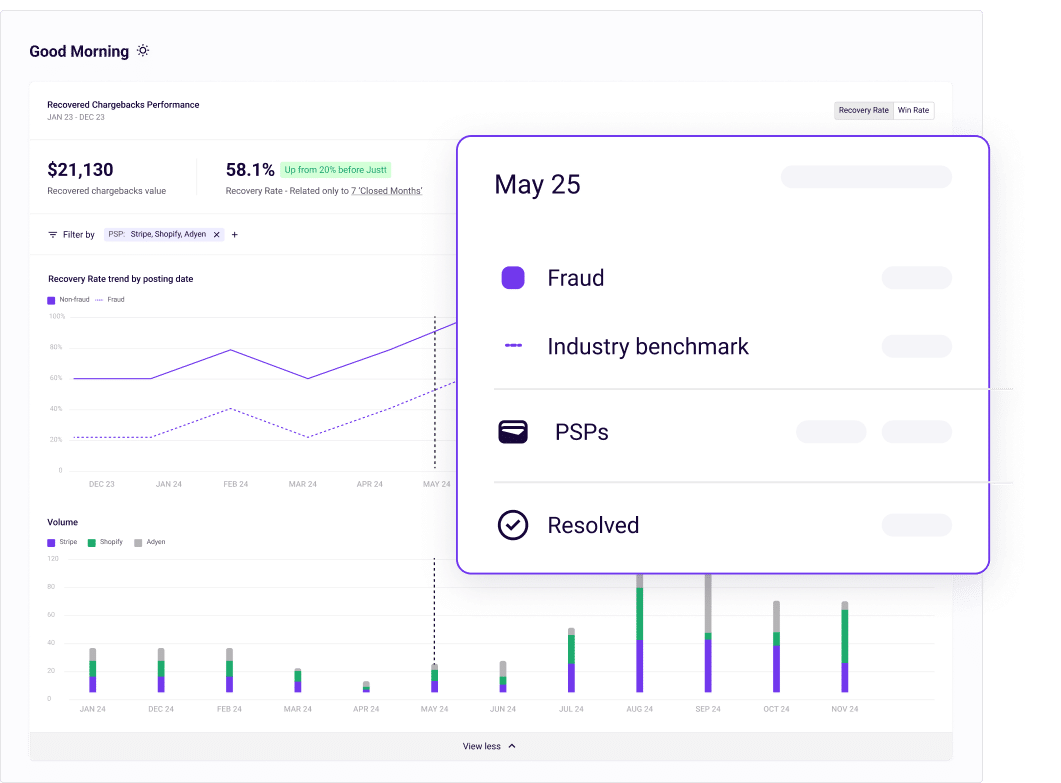
Your engineers stay on your product. Your payments team keeps full visibility through one dashboard across PSPs.
If you want to see how Justt handles the full dispute lifecycle, request a demo or explore the platform.
FAQs
Why can’t an internal AI model just get better over time?
It can, but only within the limits of your own data. A single-merchant model sees one customer base and one issuer mix, with no market benchmark pushing it forward. A specialist platform learns from far more disputes and has to keep improving to keep its customers.
How often do card network rules change, and does it really matter?
Card networks regularly change their rules, and our guide to Visa chargeback rules shows how detailed a single network’s rules get. Recent examples include Visa CE 3.0 in 2023 and the evolved VAMP in 2025. Every change your system misses costs disputes until you catch up.
What does it actually take to build a viable in-house chargeback system?
The AI model is the smaller part. You also need data pipelines, card scheme formatting, issuer-level logic, deadline management and a permanent team to maintain all of it.
What is success-based pricing for chargeback management?
The vendor is paid only when a chargeback is recovered, so its incentives match yours.